Why Your Kids Should Try Climbing: A Parent's Guide
Indoor climbing suits almost any child, any age, any body. Here is why it works for kids, what it costs and how to start.
Walk into a climbing gym on a Saturday morning in Bangkok, Kuala Lumpur or Jakarta and you will see a six-year-old working out a route while a teenager two metres to her left tries the same problem a different way. Neither is waiting for a coach to tell them where to put their hands.
That scene is why plenty of parents now put climbing on the weekly schedule next to swimming and football. Here is the case for it.
It's a whole body (and mind) sport
Climbing uses legs, core, back, arms and fingers together, so children get stronger without ever doing a "workout". They learn to balance, to trust their feet and to move their weight. Coordination improves because the wall demands it.
The mental side is just as useful. Every route is a puzzle. Your child looks at the holds, plans a sequence, tries it, falls, and tries again with a better plan. That loop teaches problem solving and persistence in a way a worksheet cannot. Falling on a padded floor or onto a rope teaches something too: a miss is information, not failure. It builds resilience in the face of challenge in a controlled and supportive environment.
Confidence follows. A child who could not reach the top last month and now can has proof that effort works.
There is no bench to sit on
In most team sports, the strongest kids get the ball. Climbing works differently. Each child climbs at their own level on routes graded from easy to very hard, and the competition is mostly with the wall and with yesterday's version of themselves. A shy child can climb next to a confident one and both get what they need.
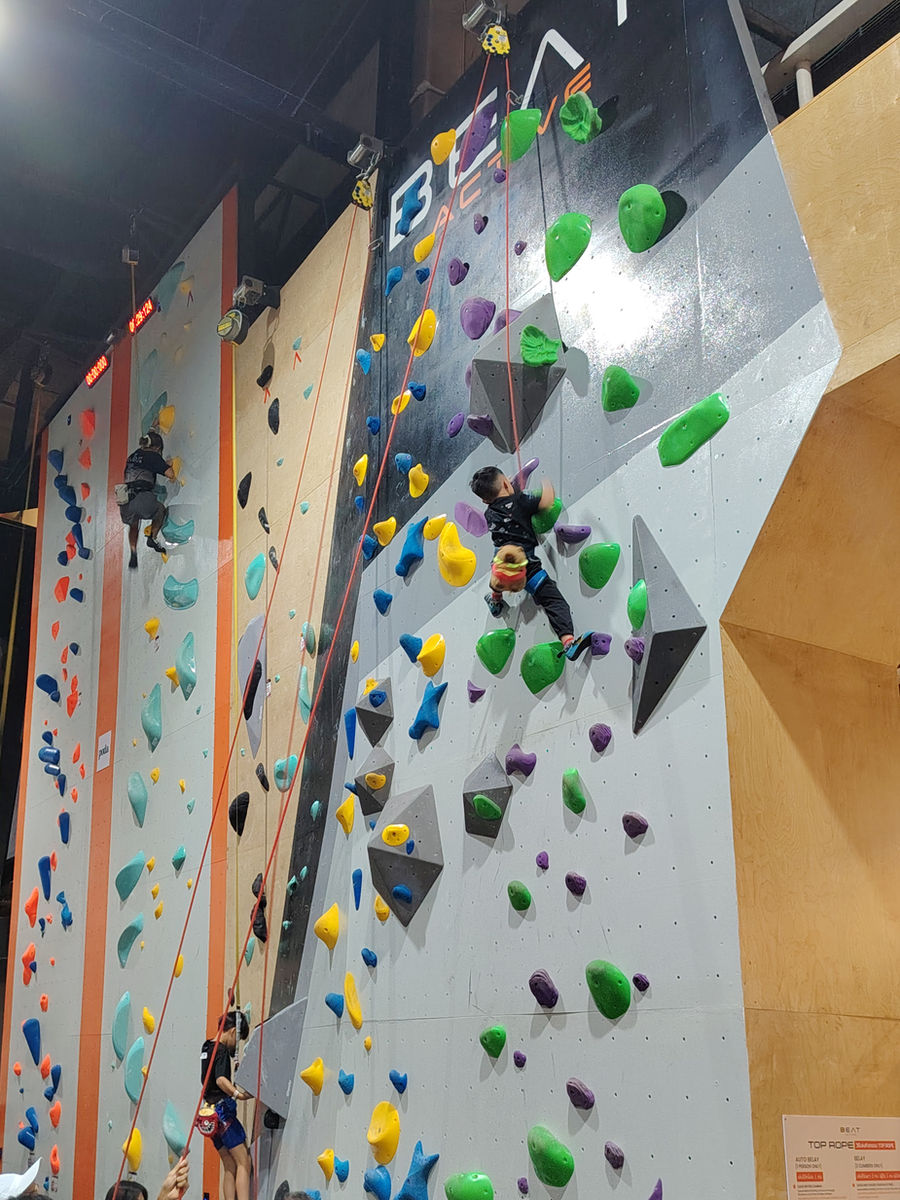
That makes climbing one of the few sports where a small kid, a tall kid, a strong kid and a flexible kid can all find a way up. Different bodies solve problems differently, and coaches know it.
The community is a big part of it
Climbing gyms run on encouragement. Strangers cheer when a kid finally sticks a move. Older climbers share tips and chalk. Children make friends across school years and across the gym, and parents end up chatting by the mats while the kids climb. Even better, they can join in at their own level.
Many gyms also run kids' classes, junior programmes and holiday camps with qualified coaches. Climb SEA lists these on the classes page, so you can compare what is on offer in your city. In Singapore, for example, Upwall has a holiday climbing camp in December and Outpost runs a junior programme.
The strength of the community can't be overstated, and the vibes in gyms within South East Asia are in a league of their own.
It is easy to find and easy to try
Climb SEA now lists over 120 climbing gyms across Thailand, Malaysia, Singapore, Indonesia, the Philippines, Vietnam, Cambodia, Myanmar and Brunei, with more being added. Most major cities have several, and most offer a day pass and shoe rental, so a first visit does not need any gear or commitment.
Kids' day passes are usually cheaper than adult entry. In our listings, a standard child or youth pass costs about 300 to 420 baht in Bangkok and S$10 to S$22 in Singapore. Shoe rental is often extra, so check the gym page for current prices.
Indoor climbing also solves a local problem. Heat and monsoon rain cancel a lot of outdoor sport here. Gyms run all year, and many are air-conditioned. Check the gym page for hours, prices and what each gym offers, then book an intro class if your child is new, or just turn up and try it out.
Browse by city on the gyms page and start with whichever is closest to home or school. Check the map view to get a clearer picture.
The youth comp scene is growing
Some kids want to compete, and the region now gives them somewhere to do it. Climb SEA tracks youth comps across South East Asia, and recent and upcoming examples show how wide the range is:
- Spider Kids 2026 at BEAT Active in Bangkok ran on 15 November, with three age groups, boys and girls ranked separately, in top rope and bouldering.
- Climb On Student Boulder Festival in Jakarta (13 December) groups climbers by school level.
- Open Jakarta Utara Youth Climb (18 to 21 December) runs lead and speed in U11, U13 and U15.
- CRANK Youth 2027 in Kuala Lumpur sorts climbers into age groups by birth year.
- Camp5 Inter-School Climbing League at Camp5 1 Utama gives school teams a league to climb in.
Check the events page for current dates, fees and categories before you plan around any of these. Questions? Email hello@climbsea.com or message @climb_sea on Instagram.
A comp does not have to mean pressure. For most kids the first one is a day out with friends, a new gym, a number on a bib, a bag of swag to take home and a lot of snacks. The atmosphere in comps is similar to the day-to-day in the gyms: supportive and encouraging whilst being focused on individual performance. Climbing has been an Olympic sport since Tokyo 2020, which gives older kids a long-term goal if they want one.
It can sit comfortably next to school
Parents worry about adding another activity to a full week. Climbing fits better than most because the schedule is flexible. Gyms open early and late, there's plenty of comfortable space (often with a cafe) for parents to join, and your child can climb less frequently during exams and more often in quieter periods.
Many parents also value the break itself. An hour on the wall means no screen, full attention on a physical and mental problem, and a tired child who sleeps well. Regular exercise tends to help children concentrate, though every child is different and climbing is no substitute for study. As a counterweight to a heavy academic load, it is hard to beat.
Comps usually fall on weekends and school holidays, and school leagues and student events are built around the school calendar.
Safety, honestly
Climbing is safer than its reputation, but like any sport, it's not without risks. Gyms use thick padding for bouldering, auto-belays and trained staff for ropes, and clear rules on where to stand. Most injuries are sprains and scrapes. Choose a gym that gives a proper safety briefing and take it easy at first. Sign up for an intro class or beginner course before letting your child climb unsupervised.
Learning how to fall safely whilst bouldering is one of the most important first steps.
One point for parents of young climbers: growing fingers, tendons and joints need time. Good coaches keep training varied and avoid hard, repetitive finger loading in children.
What to look for in a gym
- A safety briefing for new climbers, and staff who supervise the kids' area.
- A beginner or kids' class with a qualified coach. Ask how many children each coach looks after.
- Clear age and supervision rules, given when you sign the waiver.
- Thick mats under the bouldering walls, so a fall from low down costs nothing.
- Auto-belays are very helpful for beginners starting rope climbing.
- Beginners' walls, kids' areas, or specific kids' routes are available in some of the larger gyms.
- Convenience and comfort. Climbing can be addictive and you find yourself going often!
How to start
- Pick a gym near home or school on the gyms page.
- Book a day pass or an intro class and rent shoes on the day.
- Keep the first sessions short, about an hour, and let your child lead.
- Come back weekly for a month before deciding anything.
- If your child loves it, look at a kids' class, a junior programme, or a first comp.
A first visit costs a day pass and an hour of your Saturday. Pick a gym and see whether your child asks to go back. You may want to try it out a few times to get through the initial learning curve and see progress.
Kids climbing: questions and answers
What age can kids start climbing?
Most gyms accept children from around four or five on bouldering walls and in kids' classes, and some run toddler sessions. Check each gym's rules, since age limits and parent supervision requirements vary.
Do kids need their own shoes or gear?
No. Gyms rent climbing shoes, and chalk is optional for beginners. Buy shoes only once your child climbs weekly and has stopped outgrowing them every few months.
How much does a kids' climbing session cost?
Child and youth day passes in our listings cost roughly this much, in local currency:
- Bangkok: 300 to 420 baht, or from 200 baht off-peak
- Kuala Lumpur: RM12 to RM40
- Singapore: S$10 to S$22
- Manila: 500 to 550 pesos
- Jakarta: Rp50,000 to Rp120,000 where a student or child rate exists, and not every gym has one
Shoe rental is often extra, and prices vary with age band and peak or off-peak times. Check the gym page for current prices.
Is climbing safe for children?
At a well-run gym, yes. Padding, auto-belays and staff supervision cover the main risks. Pick a gym with a safety briefing and trained coaches, and follow the gym's rules on supervision.
Is climbing good for kids who are not sporty?
Yes. There is no team to be picked for and no ball to catch. Children climb at their own level, which makes it easier for less-sporty kids to enjoy. The individual progress is what makes it valuable, and the mental side of solving problems is balanced alongside the physical challenge.
Do I need to climb too?
No, but many parents end up doing it. Most gyms let adults climb alongside, so you can try it together.
Where can I find kids' classes and comps near me?
Use Climb SEA's classes page for courses and camps, and the events page for youth comps, filtered by city.